
What Are Peptides? A UK Guide
A peptide is a short chain of amino acids joined by peptide bonds. Longer chains are called proteins; the line between the two is conventional rather than exact.
What a peptide actually is
A peptide is a chain of amino acids linked by peptide bonds — the bond formed when the carboxyl group of one amino acid joins the amino group of the next, releasing water. The length of the chain is what separates the vocabulary: a dipeptide has two residues, a tripeptide three, an oligopeptide a handful, and a polypeptide many. Above roughly fifty residues the same molecule is usually called a protein, but that boundary is a convention of usage rather than a chemical rule.
Several names in this catalogue describe the structure directly. GHK-Cu is a copper-binding tripeptide — three residues, glycine-histidine-lysine, with a copper ion. BPC-157 is a pentadecapeptide: fifteen residues. Once you can read the prefix, the name tells you the size of the molecule.
Why the sequence matters more than the length
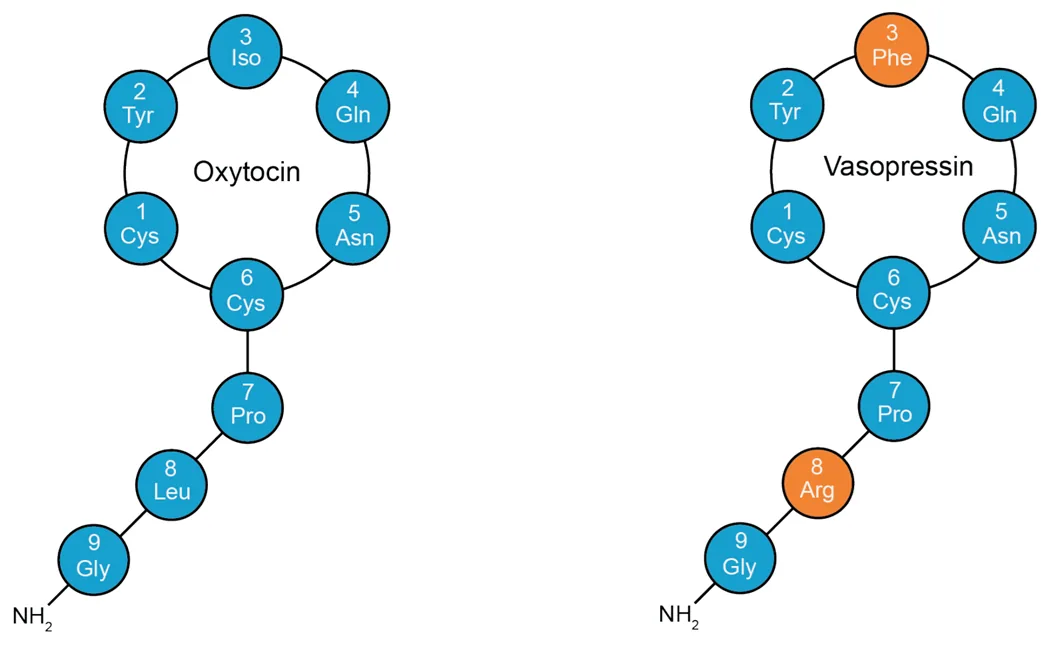
Two peptides of identical length can behave completely differently, because the order of the residues determines the shape the chain folds into and therefore what it binds to. This is why a single substituted amino acid produces a distinct compound with a distinct name, and why suppliers list a sequence rather than just a molecular weight.
It is also why closely-named compounds are not interchangeable. CJC-1295 DAC and CJC-1295 without DAC differ by a drug-affinity complex that changes the molecule's half-life; TB-500 is a synthetic fragment related to thymosin beta-4 rather than the full protein. The distinction is in the documentation, not the marketing name.
How peptides are supplied
The standard laboratory format is a lyophilised vial: the material is freeze-dried to a stable powder under vacuum and sealed. Lyophilisation removes the water that would otherwise drive hydrolysis, which is why powder is stable at ambient temperature for shipping while a solution generally is not. Quantity is stated in milligrams, and that figure is what separates one size from another — a 5mg and a 10mg vial are the same compound at the same purity.
- Vials — lyophilised powder, reconstituted before use. The most common format.
- Pens — supplied pre-filled, with the compound already in solution.
- Capsules — an oral format, supplied in a sealed bottle.
- Nasal sprays — supplied ready-assembled in a metered bottle.
Reconstitution, in one paragraph
A lyophilised vial is brought back into solution with bacteriostatic water — sterile water containing approximately 0.9% benzyl alcohol, which is what makes it bacteriostatic and therefore suitable for a vial that will be accessed more than once. The quantity of compound and the volume of water together give a concentration: 10mg reconstituted with 2ml yields 5mg per ml. Our peptide calculator does that arithmetic.
Why the same compound has several spellings
The same molecule circulates under several names, and the differences are rarely meaningful. A copper tripeptide appears as GHK-Cu, GHK Cu, GHK copper or simply copper peptide. BPC-157 appears as BPC 157 and, frequently, as the transposition BCP-157. TB-500 is listed as TB500, thymosin beta-4, thymosin b4 and T beta 4.
Each product page on this site lists the variants it is also known by, so a specification can be compared like-for-like between suppliers rather than being matched on the spelling of a label.
Purity, and what a percentage refers to
A purity figure such as ≥99% describes the proportion of the material that is the stated peptide, with the remainder being residual synthesis reagents, water and closely-related sequences. It is determined analytically, typically by HPLC. A purity figure is a statement about the contents of the vial, and it is separate from — and says nothing about — the regulatory status of the compound inside it. That status is covered on are peptides legal in the UK.
Frequently asked questions
What is a peptide?
A short chain of amino acids joined by peptide bonds.
What does lyophilised mean?
Freeze-dried to a stable powder, which is the standard way peptides are supplied in vials.
What is the difference between a vial and a pen?
A vial holds lyophilised powder for reconstitution; a pen arrives pre-filled and ready to use.